

Introduction
Plastic packaging has become a major part of modern life, especially as e-commerce continues to bring millions of products directly to our doorsteps. However, its convenience comes with a growing waste problem. People often use this packaging for only a short time before discarding it, which puts pressure on waste-management systems and the environment. This growing challenge is pushing businesses to consider biodegradable packaging for e-commerce as a more sustainable alternative.
This has created a bigger sustainability challenge: how can we protect products without creating more long-lasting waste? Interestingly, the answer may come from materials that were once considered waste themselves. Blue crab shells can provide chitosan for packaging applications, while mushrooms are inspiring new protective packaging materials. Other agricultural and biological wastes are also opening new possibilities.
In this blog, we explore unique biodegradable packaging innovations in 2026, inspired by materials connected to our daily routines and the products we order from various e-commerce platforms.
What Do Consumers Actually Expect From Sustainable Packaging?
Consumers may want more sustainable packaging, but they do not want sustainability to make their shopping experience worse. When someone receives an online order, they still expect the package to arrive safely, open easily, and protect the product inside.
This is where sustainable packaging needs to go beyond simply using a different material. Customers increasingly appreciate packaging that uses fewer unnecessary materials, is easy to handle, and provides clear disposal instructions. Reusable or home-compostable options can also make the experience more practical.
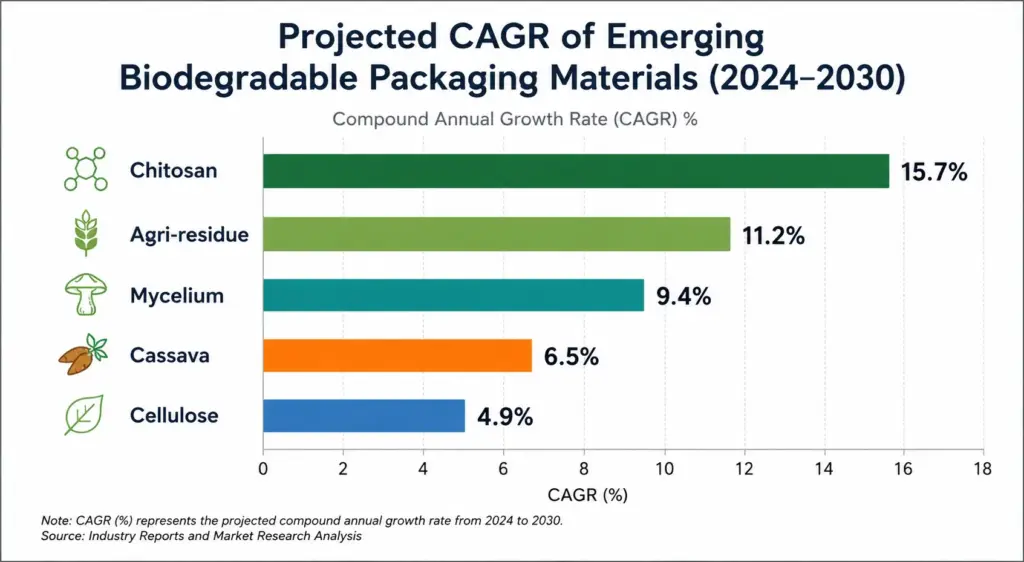
The market is expanding rapidly, with emerging biodegradable materials showing different growth rates and packaging opportunities across industries as companies seek practical alternatives to conventional plastics.
Why Is Replacing Plastic Packaging So Difficult?
Plastic waste comes in many different types and materials, such as PET used in bottles and packaging, PE in bags and containers, and PP in packaging and other products. However, recycling facilities often need to sort these materials separately when they mix together before they can recycle them effectively.
And the numbers show the scale :
- Only 9% of plastic waste gets recycled.
- 79% of plastic waste ends up in landfills.
- 12% of plastic waste gets burned, releasing CO₂.
Main Challenges of Replacing Plastic Packaging in E-Commerce
Product protection
Packaging must absorb impacts and prevent damage while products move through complex e-commerce delivery networks.
Moisture resistance
Materials must withstand humidity, rain, and accidental exposure to moisture without losing their protective properties.
Leakage prevention
Packaging for liquids, cosmetics, and food products needs reliable barriers to prevent spills during transportation.
Strength during shipping
Packages must resist compression, tearing, and repeated handling throughout storage, sorting, and delivery.
Temperature and storage conditions
Some materials can lose performance when exposed to extreme heat, cold, humidity, or long storage periods.
How Do Companies Choose the Right Biodegradable Packaging?
Companies choose biodegradable packaging based on the specific needs of the product rather than simply selecting the most sustainable-looking material. Factors such as product weight, moisture sensitivity, leakage risks, shipping distance, temperature conditions, required protection, cost, and disposal infrastructure all influence the final choice.
Types of Biodegradable Packaging Materials:
Companies increasingly develop biodegradable packaging from materials that people once considered waste. Instead of relying only on conventional alternatives, researchers are exploring natural resources and biological materials that can offer new possibilities for product protection and sustainability.
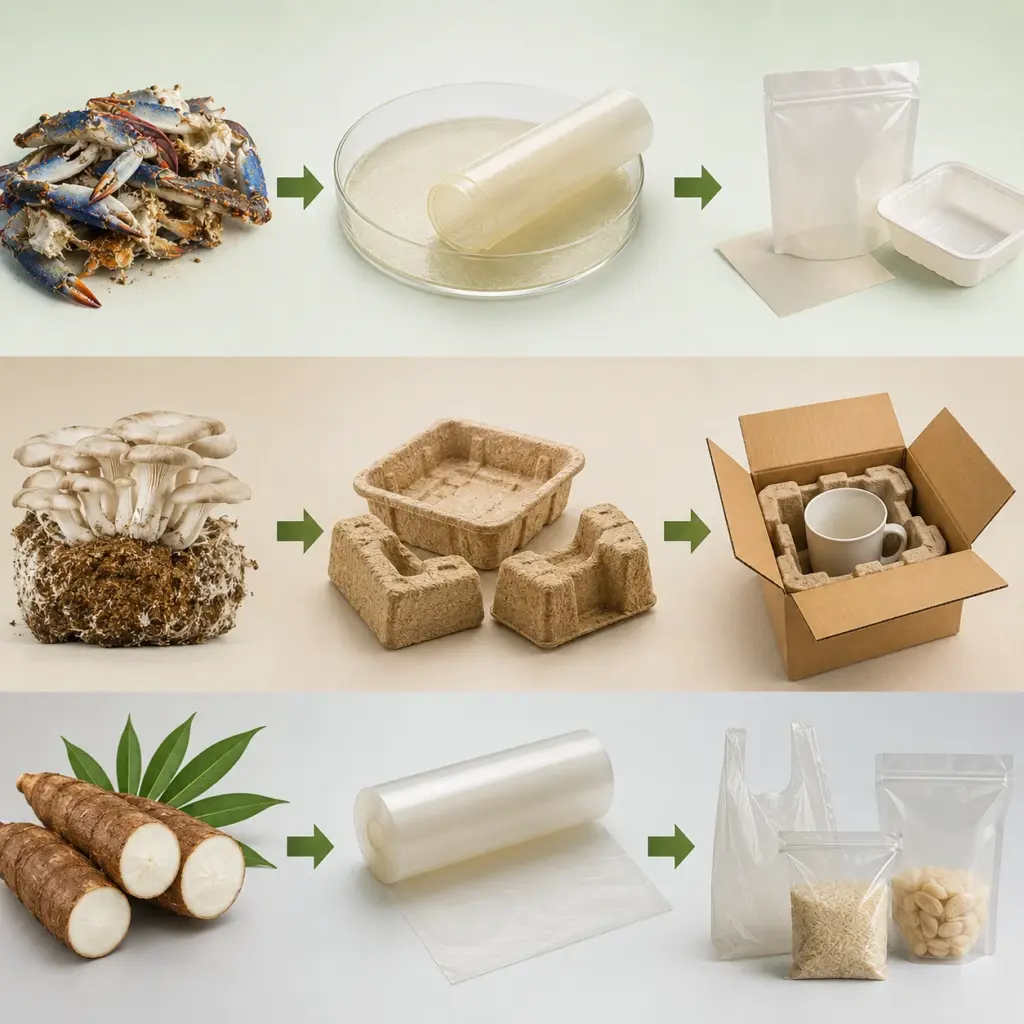
Chitosan From Blue Crab Shells
Blue crab shells contain chitin, which can be processed into chitosan, a biodegradable material being explored for films and coatings. Its potential properties, including antimicrobial activity and film-forming ability, make it an interesting material for future packaging applications.
Mushroom-Based Packaging
Mushroom-based packaging uses mycelium, the root-like structure of fungi, combined with agricultural waste to create protective materials. These materials can be molded into different shapes, offering a potential alternative to conventional protective packaging such as plastic foams.
Cassava Starch-Based Packaging
Cassava starch can be processed into biodegradable films and flexible packaging, offering a plant-based alternative to conventional plastics. Its natural film-forming properties make it a promising material for lightweight packaging applications.
These innovations show how we can transform biological waste and natural resources into biodegradable packaging, creating new alternatives to conventional plastic-based materials. Patent landscape analysis can help companies understand emerging technology areas, patent activity, and the competitive landscape surrounding biodegradable packaging materials.
Which Biodegradable Packaging Material Is Right for Your Product?
Not every biodegradable material is suitable for every product. The right choice depends on what the product needs during storage, transportation, and use. Companies can use technology scouting to identify emerging packaging materials and technologies that match specific product and performance requirements.
Factors such as strength, moisture resistance, cushioning, and barrier properties can help determine which material is the most suitable. Here are some emerging biodegradable materials and how companies could use them for different types of e-commerce products:
1. Chitosan from Blue Crab Shells
Chitosan can be processed into biodegradable films and coatings. Its film-forming properties make it an interesting material for packaging applications where a protective coating or flexible material is needed.
E-commerce product examples: Cosmetics, skincare products, food items, and small personal-care products.
2. Mushroom-Based Packaging
Mushroom-based packaging can be molded into protective shapes and used as an alternative to plastic foam. It is particularly useful where cushioning and shock absorption are important during shipping.
E-commerce product examples: Electronics, glass products, home décor items, and fragile goods.
3. Nanocellulose
Nanocellulose is a lightweight material being explored for packaging because it can offer high strength and useful barrier properties. It may help develop thinner and lighter packaging materials without compromising performance.
E-commerce product examples: Cosmetics, food products, lightweight consumer goods, and premium product packaging.
4. Agricultural Residue-Based Materials
Agricultural residues, such as crop by-products, can be converted into packaging materials instead of being treated only as waste. These materials can support the development of molded, paper-like, or protective packaging solutions.
E-commerce product examples: Clothing, books, accessories, household products, and other non-fragile goods.
5. Cassava Starch-Based Packaging
Cassava starch can be processed into biodegradable films, bags, and lightweight packaging. It is especially interesting for applications where flexible packaging and reduced dependence on conventional plastic are needed.
E-commerce product examples: Clothing, dry food products, lightweight household items, and small consumer goods.
Beyond Materials: How Innovation Is Transforming Sustainable Packaging
Beyond innovative materials, new technologies are helping companies design smarter packaging, reduce unnecessary waste, improve disposal guidance, and optimize packaging for real-world e-commerce needs.
Self-Healing Bio-Coatings
Self-healing bio-coatings protect packaging by reducing the impact of small cracks and surface damage. They can also extend packaging durability, improve product protection, and reduce the need for frequent replacement.
How they work in real life: If a small crack develops in the coating during handling or transportation, the material can respond by closing or repairing the damaged area. This could help the package maintain its barrier against moisture or oxygen instead of losing protection immediately.
Active Packaging Technologies
Active packaging goes beyond simply wrapping a product. This packaging technology interacts with the product or the environment inside the package, helping maintain product quality and extend shelf life.
How they work in real life: For example, active packaging may absorb excess oxygen or moisture inside a food package, helping slow spoilage. Some systems can also use antimicrobial components to help protect the product during storage.
Advanced Bio-Based Barrier Coatings
These bio-based protective coatings improve the performance of paper and fibre packaging by adding a protective layer to the material.
How they work in real life: Paper packaging alone can absorb moisture, oil, or grease. A bio-based barrier coating adds an extra protective layer, allowing the package to better resist these conditions while reducing the need for conventional plastic-based coatings.
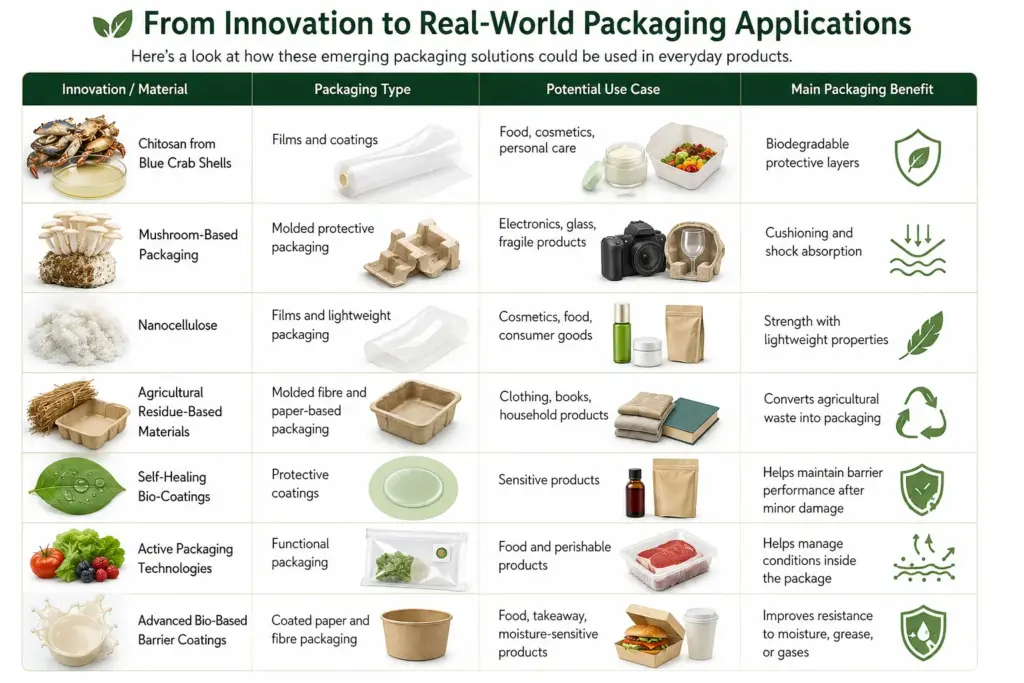
From Innovation to Real-World Packaging Applications
Here’s a look at how companies could use these emerging packaging solutions in everyday products to improve sustainability, product protection, shelf life, and overall packaging performance.
| Innovation / Material | Packaging Type | Potential Use Case | Main Packaging Benefit |
| Chitosan from Blue Crab Shells | Films and coatings | Food, cosmetics, personal care | Biodegradable protective layers |
| Mushroom-Based Packaging | Molded protective packaging | Electronics, glass, fragile products | Cushioning and shock absorption |
| Nanocellulose | Films and lightweight packaging | Films and lightweight packaging | Strength with lightweight properties |
| Agricultural Residue-Based Materials | Molded fibre and paper-based packaging | Clothing, books, household products | Converts agricultural waste into packaging |
| Self-Healing Bio-Coatings | Protective coatings | Sensitive products | Helps maintain barrier performance after minor damage |
| Active Packaging Technologies | Functional packaging | Food and perishable products | Helps manage conditions inside the package |
| Advanced Bio-Based Barrier Coatings | Coated paper and fibre packaging | Food, takeaway, moisture-sensitive products | Improves resistance to moisture, grease, or gases |
Why Should Businesses Consider Biodegradable Packaging in the First Place?
As companies explore new packaging strategies, the focus is shifting from simply replacing plastic to solving specific challenges such as protection, moisture resistance, shelf life, and material efficiency.
Better product protection: Innovations such as mushroom-based packaging and advanced coatings can provide cushioning and protective properties for sensitive or fragile products.
Improved barrier performance: Bio-based and nanomaterial coatings can help packaging resist moisture, oxygen, and grease, addressing limitations of conventional fibre materials.
Longer product shelf life: Active packaging technologies can help manage moisture, gases, or microbial activity, supporting better protection for sensitive products.
Turning waste into value: Materials derived from crab shells and agricultural residues can create new packaging applications from resources that might otherwise be discarded.
More product-specific solutions: Companies can combine materials, coatings, and packaging designs to develop solutions based on their product and shipping requirements.
How Is the Biodegradable Packaging Market Growing?
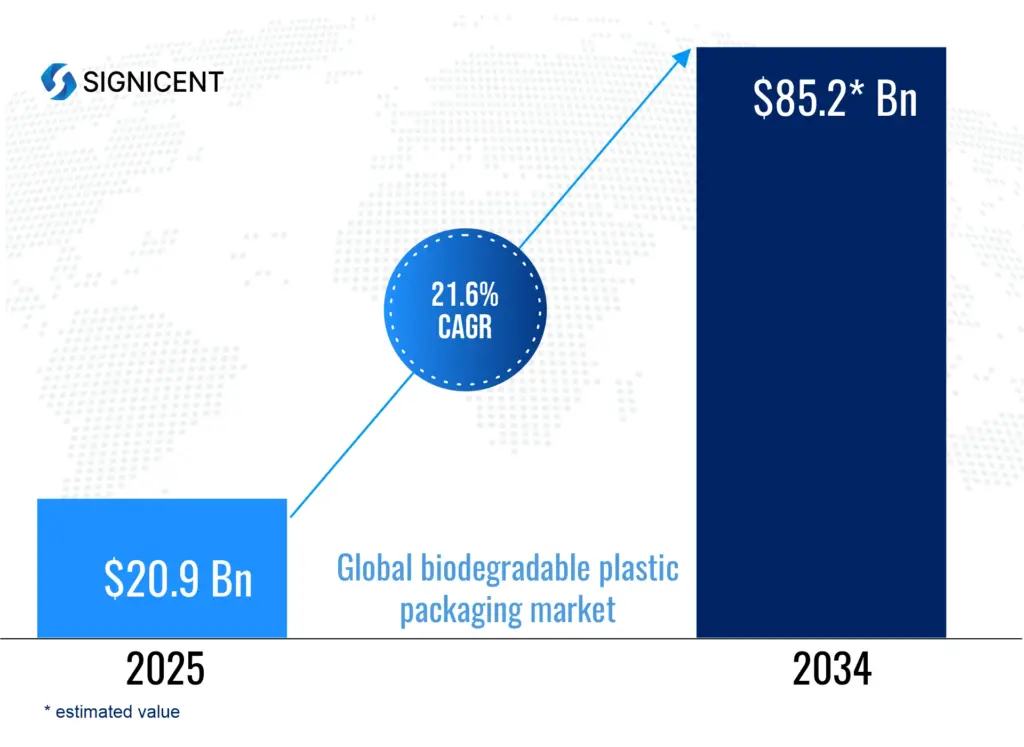
As per Signicent’s market research, the global biodegradable plastic packaging market is projected to grow at a CAGR of 21.6%, increasing from $20.9 billion in 2025 to an estimated $85.2 billion by 2034.
Stricter plastic regulations, rising consumer demand, e-commerce expansion, and innovations in biodegradable packaging are driving this growth by improving performance, reducing costs, and increasing scalability.
Packaging formats are evolving to meet different product and shipping needs, with bags, films, boxes, trays, and other solutions offering varied opportunities for biodegradable packaging adoption.
Below, you can see an illustrative range of packaging formats that could shape the future of the sustainable packaging market.
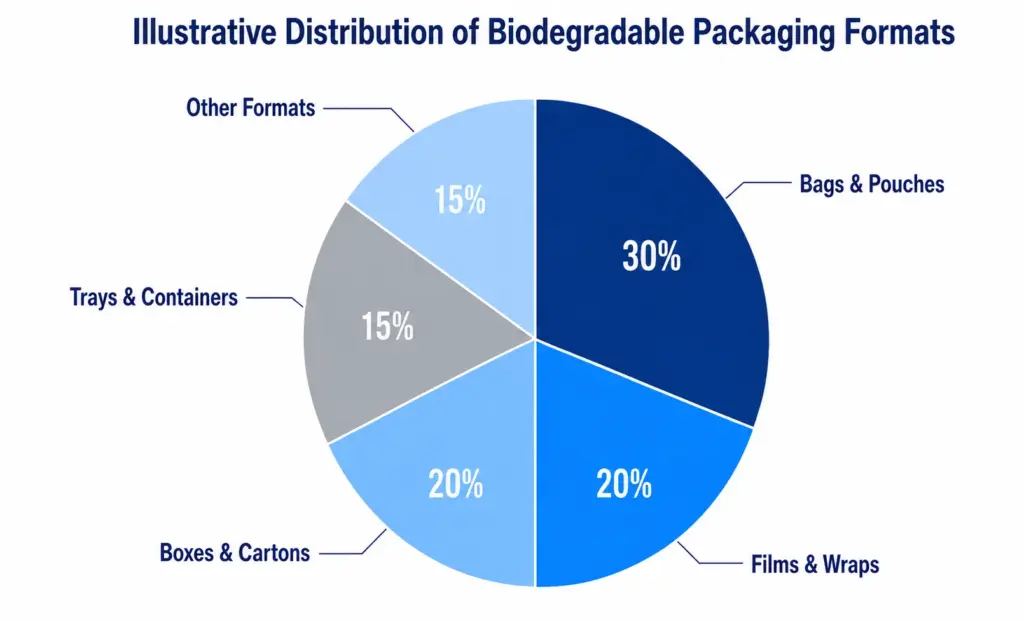
Note: Percentages are approximate and illustrative, intended to show potential distribution rather than reported market shares.
Global Companies Developing Biodegradable Packaging Innovations in 2026
- Ecovative: Develops mycelium-based protective packaging using agricultural waste as an alternative to petroleum-based foams.
- Notpla: Develops seaweed-based packaging, coatings, and flexible formats designed to replace conventional plastic packaging.
- TIPA: Develops compostable flexible packaging designed to provide plastic-like flexibility and barrier performance.
- Shellworks: Develops bio-based packaging materials designed to provide plastic-like functionality while being home-compostable.
- Magical Mushroom: Produces molded mycelium packaging for electronics, cosmetics, consumer products, and other applications.
Competitive monitoring can help businesses compare emerging packaging technologies, key companies, product strategies, market positioning, and strategic developments to identify opportunities and make informed decisions.
Signicent’s Contribution to Sustainable Packaging
We have supported clients across global packaging markets, covering solutions from mono-material packaging to biodegradable alternatives. Our work focuses on emerging materials, targeted markets, patent landscapes, and freedom-to-operate analysis to help clients make clear decisions.
Our solutions are client-centric and strategy-driven, addressing specific pain points around technology selection, competitive positioning, patent risks, and market opportunities. This helps businesses move promising biodegradable packaging innovations in 2026 toward practical, informed decisions.
Conclusion
Biodegradable packaging is moving beyond the simple goal of replacing plastic. New materials such as chitosan, mycelium, cassava starch, nanocellulose, and agricultural residues are creating different ways to reduce packaging waste. At the same time, biodegradable packaging innovations in 2026, including advanced coatings and active packaging, are helping address practical challenges such as moisture, strength, shelf life, and product protection.
From a circular economy perspective, the bigger opportunity is to keep materials in use for longer, recover value from waste, and design packaging around realistic end-of-life pathways. The future will depend on how well companies can scale these solutions, control costs, maintain performance, and connect packaging with recycling, reuse, or composting systems. Ultimately, sustainable packaging will succeed when environmental goals and everyday product needs work together.
FAQs on Biodegradable Packaging
1. Is biodegradable packaging more expensive than plastic?
Biodegradable packaging can cost more because of material, processing, and scale limitations, although larger production and improved technologies may reduce costs over time.
2. Can biodegradable packaging protect products as well as plastic?
Some innovations can improve strength, cushioning, and barrier performance, but suitability depends on the product, shipping conditions, moisture, temperature, and required protection.
3. What innovations are making biodegradable packaging more practical?
Chitosan films, mycelium packaging, active packaging, advanced bio-based coatings, and composite materials are being developed to improve performance and scalability.
4. Will biodegradable packaging become more affordable in the future?
Greater manufacturing scale, improved processing, material innovation, and stronger supply chains could help narrow the cost gap with conventional plastics.
5. What will biodegradable packaging look like in the future?
Future packaging is likely to combine bio-based materials with intelligent coatings, active functions, optimized designs, and clearer end-of-life pathways for circular systems.